
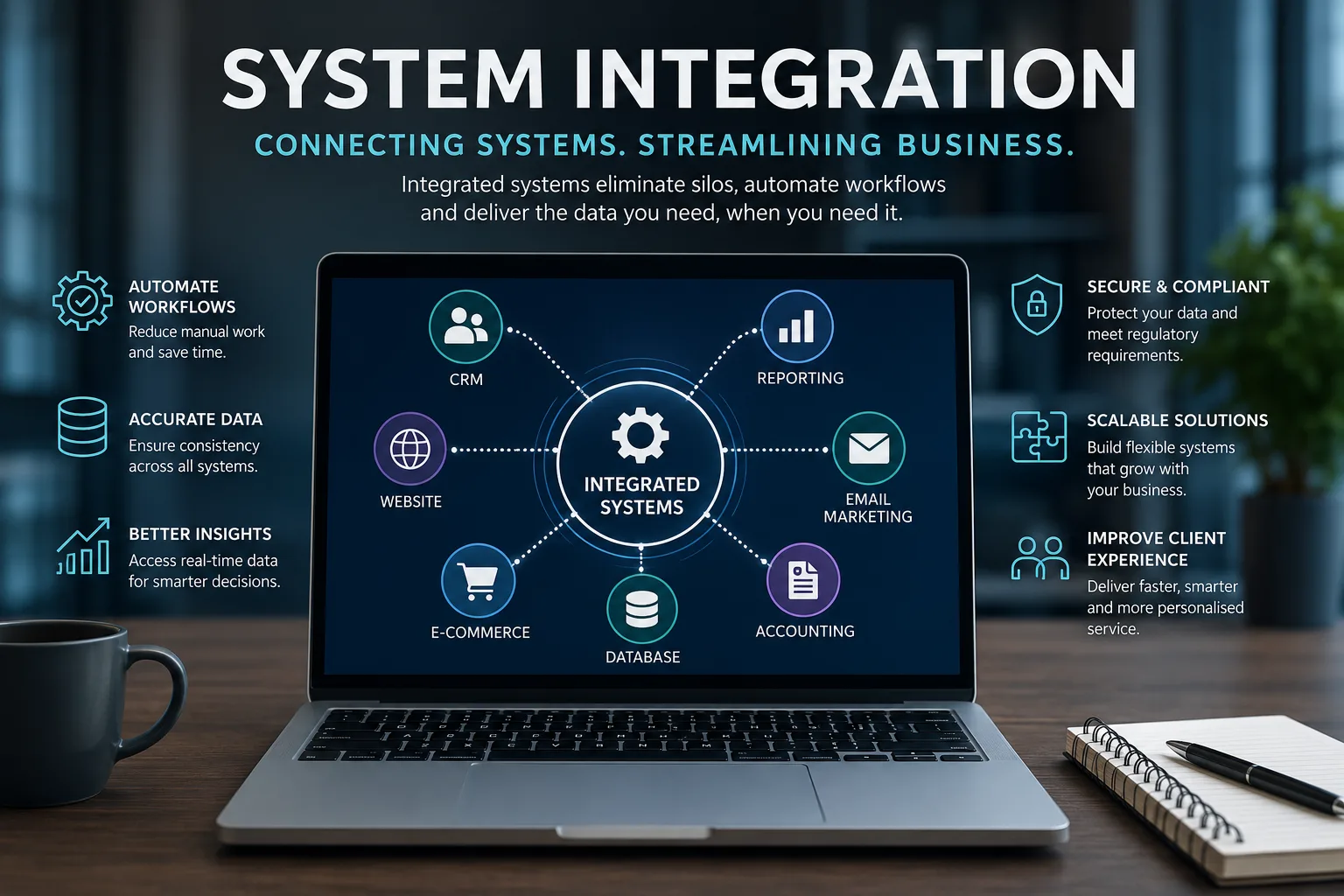
Integration challenges can be significant, but with effective strategies, we can address them successfully.
Summary
System integration is a complex but increasingly important undertaking for digital agencies and growing businesses. As organisations adopt more software platforms, they often find themselves managing disconnected websites, customer relationship management systems, accounting software, email platforms, reporting tools and internal applications. When these systems do not communicate effectively, employees are forced to duplicate information, move data manually and rely on fragmented processes.
Successful system integration connects these separate platforms so that information can move accurately and securely between them. This may involve API integrations, middleware, workflow automation, custom software development or a combination of technologies. The correct approach depends on the organisation’s existing infrastructure, operational requirements and long-term business goals.
This article examines the most common system integration challenges facing agencies and businesses, along with practical strategies for creating connected business systems that improve productivity, reporting and client service.
Table of contents
Understanding the Challenges
Integrating varied systems presents several technical and operational challenges. Every organisation has a different technology environment, and even businesses in the same industry may use completely different combinations of software, databases and internal processes.
One of the most common problems is incompatible software. Modern cloud platforms typically provide REST APIs, webhooks and other integration options, while older systems may have limited connectivity or rely on outdated data formats. Connecting a modern CRM to a legacy accounting or operational system can therefore require custom middleware or purpose-built integration software.
Data inconsistency is another significant concern. One system may record a customer’s name, contact information or account number differently from another. Duplicate records, incomplete fields and inconsistent formatting can cause integrations to fail or produce unreliable reports. Data must often be cleaned, standardised and mapped before automated synchronisation can begin.
Security and regulatory compliance must also be considered. An integration may transfer personal information, financial records, employee data or confidential business information between multiple platforms. Businesses must control who can access that information, how it is encrypted and where it is stored. For South African organisations, this includes considering the requirements of the Protection of Personal Information Act, while businesses serving international clients may also need to account for regulations such as the GDPR.
Operational complexity can be just as challenging as the technology. Different departments may use the same software in different ways, and employees may have developed informal workarounds that are not documented. Automating a poorly understood process can make existing problems more difficult to correct. Before development begins, the organisation needs a clear view of how information currently moves between people, departments and systems.
Agencies face an additional challenge because they often work across several client environments. Each client may use different hosting providers, content management systems, marketing tools, CRMs and reporting platforms. A solution that works for one client may not be suitable for another. Integrations therefore need to be reliable, maintainable and adaptable without creating unnecessary technical debt.
Strategies for Success
Comprehensive Planning: Begin with a detailed discovery and planning process. Identify every system involved, what information it holds, how that information is currently used and where manual handovers take place. The integration plan should define the required data flows, user roles, security requirements, expected outcomes and potential technical limitations. A business systems consultant can help translate operational requirements into a practical technology roadmap before development begins.
Process Mapping: Document the existing workflow from beginning to end. This should include the people responsible for each stage, the systems they use and the decisions they make. Process mapping helps identify duplicated work, unnecessary approvals, communication gaps and opportunities for business automation. It also prevents a new integration from simply reproducing an inefficient manual process.
Choosing the Right Integration Method: Not every integration requires the same technical approach. Direct API integrations may be suitable when two modern platforms need to exchange information in real time. Webhooks can trigger an action when something changes, such as creating a support ticket after a website form is submitted. Middleware can connect multiple applications, while custom software may be necessary when the organisation has specialised requirements that cannot be handled by off-the-shelf tools.
Utilising Middleware: Middleware acts as a connector between separate systems and can simplify data exchange. Instead of building a unique connection between every application, the middleware receives, transforms and distributes information according to defined rules. This can be particularly useful when connecting CRMs, websites, email platforms, accounting software and internal dashboards. However, middleware should be selected carefully to avoid introducing another platform that becomes expensive or difficult to maintain.
Data Standardisation: Establish clear rules for how information should be formatted and stored. Decide which system will serve as the primary source of truth for customers, products, invoices, employees or other important records. Standardised field names, reference numbers and validation rules reduce duplication and make reporting more reliable. Where existing information is inconsistent, data cleansing should take place before migration or synchronisation.
Phased Implementation: Large integration projects are generally more manageable when delivered in stages. Begin with the process that creates the greatest operational burden or offers the clearest business value. For example, a business might first automate the flow of website enquiries into its CRM before connecting the CRM to accounting, support and reporting platforms. A phased approach reduces disruption and allows lessons from the first integration to inform later development.
Continuous Testing: Testing should take place throughout the project rather than only before launch. Developers need to test normal transactions, incomplete records, duplicate information, unavailable services and unexpected user behaviour. Automated testing and detailed error logging can help identify failures before they affect customers or business operations. User acceptance testing is also essential because employees understand the practical workflow in ways that technical teams may not.
Monitoring and Error Handling: A successful integration needs to remain dependable after deployment. Systems should record successful and failed transactions, alert the appropriate people when errors occur and allow information to be processed again without creating duplicates. Monitoring is particularly important when an integration depends on third-party APIs that may change, become unavailable or impose new usage limits.
Documentation and Training: Technical documentation should explain how the integration works, which platforms are involved and how common errors are resolved. Employees should also receive practical training on the updated workflow. Without clear documentation and user adoption, even a technically sound integration can fail to deliver meaningful improvements.
Ongoing Support and Improvement: Business processes and software platforms change over time. An integration should therefore be treated as part of the organisation’s operational infrastructure rather than as a once-off project. Regular reviews can identify new automation opportunities, changing security requirements and integrations that need to be updated or replaced.
Success Stories
The value of system integration is most visible when it solves a specific operational problem. Consider an agency receiving client enquiries through several websites and email accounts. Without integration, employees may need to copy each enquiry into a CRM, assign it manually and prepare separate reports. By connecting the websites, shared inboxes and CRM, enquiries can be captured automatically, assigned to the correct team member and included in a central reporting dashboard.
A training provider may face a different challenge. Learner information, attendance records, client details, study material logistics and financial data may be spread across several applications and spreadsheets. A connected learner management platform can centralise these processes while integrating with agent portals, reporting tools and financial systems. Management gains a clearer view of performance, while administrators spend less time reconciling information manually.
Another example is a business that operates several warehouses or service locations. Stock levels, orders, purchasing and vehicle movements may be managed independently, making it difficult to obtain an accurate operational overview. A custom logistics platform can connect inventory, order processing, fleet tracking and automated purchasing. Real-time dashboards then give management the information required to respond more quickly and make better decisions.
These examples demonstrate that successful system integration is not simply about connecting software. Its purpose is to improve how the organisation operates. The most effective integrations reduce repetitive administration, create more reliable data and make important information available to the people who need it.
Takeaway
System integration can be challenging, particularly when an organisation relies on a mixture of modern cloud applications, older software and manual processes. However, these challenges can be managed through careful planning, accurate process mapping, appropriate technology and continuous testing.
The objective should not be to connect every platform simply because integration is technically possible. Each connection should solve a defined operational problem, remove unnecessary work or improve the quality of business information. In some cases, an API integration or automation workflow will be sufficient. In others, custom software development may provide a more sustainable solution than attempting to force several generic applications to work together.
With the correct strategy, disconnected tools can be transformed into secure, connected business systems. This gives employees more time to focus on meaningful work, provides management with clearer reporting and creates a more consistent experience for clients. For agencies and businesses planning an integration project, the first step is to understand the existing workflow and develop a practical systems roadmap before choosing the technology.
Discover how we can assist in optimizing your integration processes.